Condo to Landed: The Five Costs Nobody Budgeted For
Most condo owners upgrading to landed budget carefully for the purchase price and the mortgage, and then get caught by five things that were never in the spreadsheet. None of them is a reason not to move. All of them are much cheaper to know about now than to discover in month three.
1. Stamp duty, and the ABSD timing trap
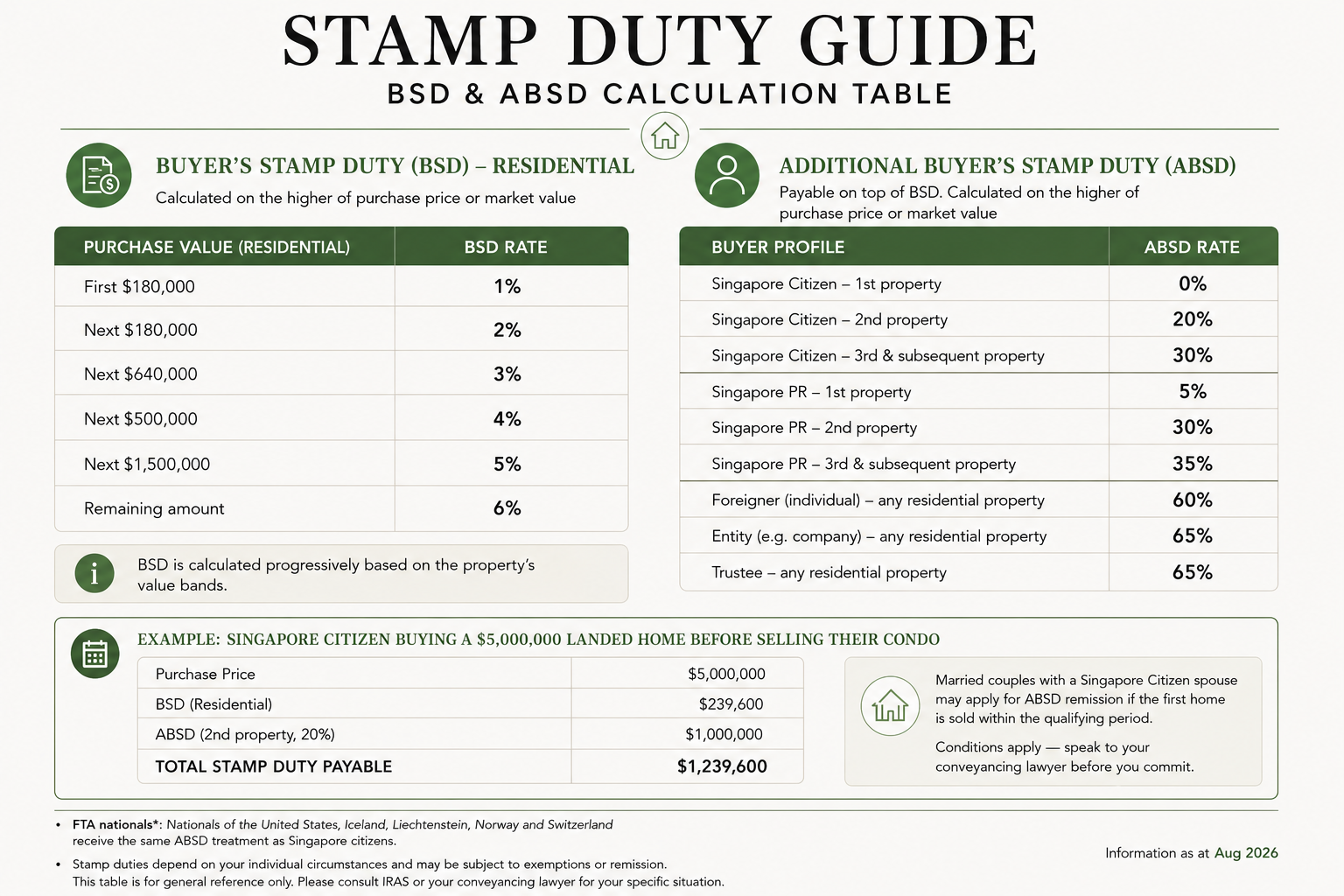
Buyer's Stamp Duty (BSD) is progressive, and on landed quantums the top tiers do most of the work. On a $5,000,000 purchase the duty is $239,600. Coming from a condo at half the price, you are not paying twice the stamp duty — you are paying considerably more than twice, because the portion above $3,000,000 is taxed at the top rate.
The bigger issue is sequencing. If you buy the landed house before you sell your condo, you own two properties at that moment, and Additional Buyer's Stamp Duty (ABSD) applies at the second-property rate — 20% for a Singapore citizen. On a $5,000,000 house that is $1,000,000, on top of the $239,600 in Buyer's Stamp Duty. So before you have paid a cent towards the house itself, $1,239,600 has to exist, upfront, even though you fully intend to sell the condo.
Put that next to the downpayment and the scale becomes clear. On the same $5,000,000 purchase with a 75% loan, your downpayment is $1,250,000. The tax bill in a buy-first scenario is $1,239,600 — almost exactly the same size as the entire downpayment. You are, in effect, funding the purchase twice over on the day you sign.
2. Property tax rises more than you expect
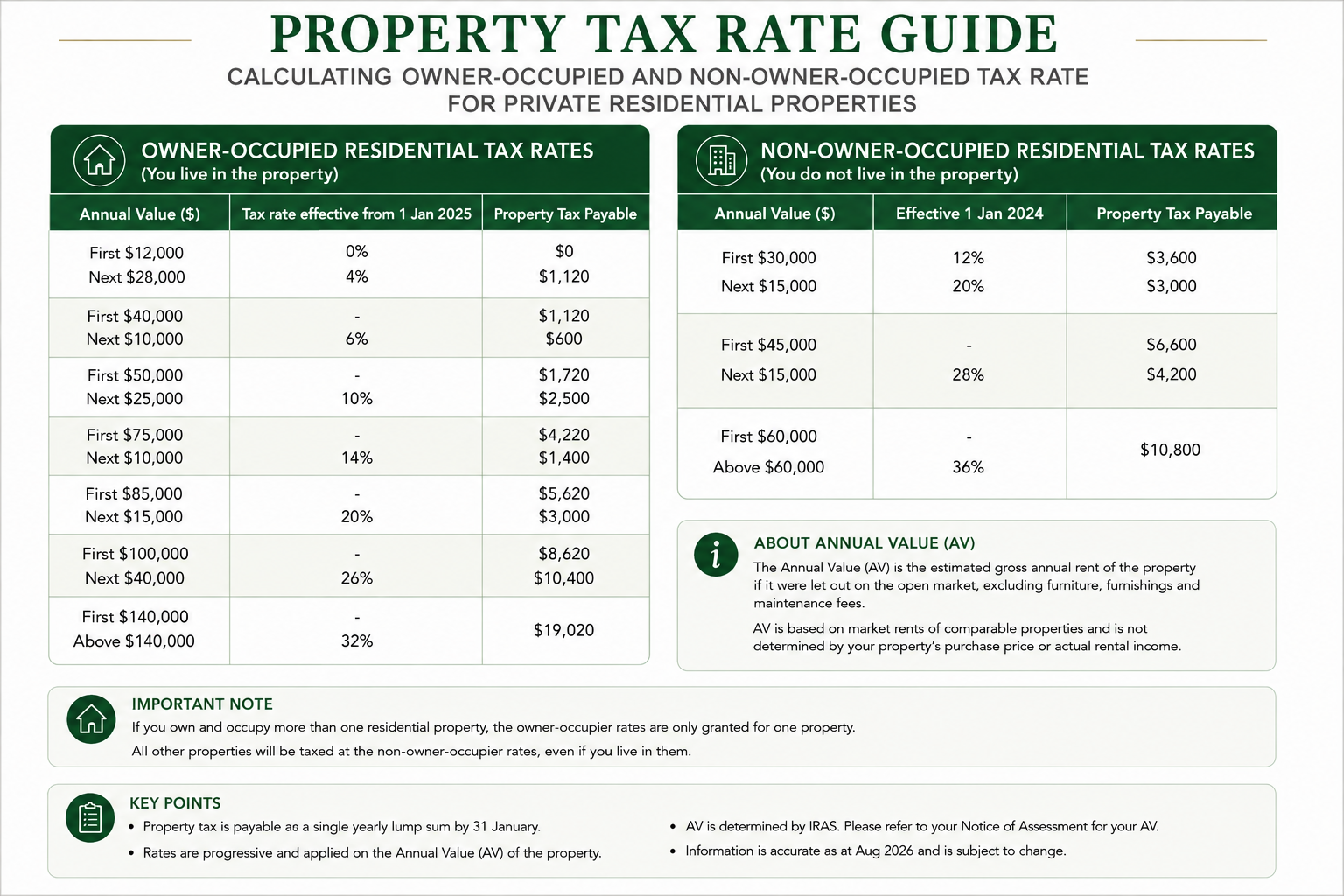
Owner-occupier property tax is charged on annual value at progressive rates, and a landed home's annual value is typically far above that of a condo at a similar price, because the land is doing the work.
Most people mentally offset the higher tax against the condo maintenance fee they are escaping. Do the actual sum for the actual house rather than assuming it nets off. It frequently does not, and the difference is a recurring annual cost for as long as you own the home.
3. You are now the management corporation
This is the item that surprises people most, because it is not one cost but a permanent list of them. Nobody is going to paint the outside of your house, clear your gutters or fix the pump.
● Roof inspection, repair and eventual re-roofing
● Gutters and rainwater downpipes
● External painting on a cycle of several years
● Waterproofing, especially flat roofs, balconies and bathrooms
● Termite treatment and general pest control
● Plumbing, drainage and the water pump
● Gate motor, intercom, alarm and cameras
● Landscaping and tree pruning
● A reserve for whatever fails without warning, because something will
Budget an honest annual figure for this from the start and set it aside monthly, the way the management corporation used to. Owners who treat maintenance as a series of emergencies pay considerably more than owners who treat it as a standing cost.
4. The renovation gap
Move-in condition on a landed house of a certain age usually means the house is habitable, not that it is done. Re-roofing, rewiring, waterproofing and plumbing tend to arrive within the first few years regardless of how good the place looked at the viewing.
If your plan is an Addition and Alteration (A&A) project or a full rebuild, budget three things that get left out:
● Professional fees. Architect, professional engineer, and the submissions to the authorities. These are a real percentage of the construction cost, not a rounding error.
● Time. A rebuild is commonly a matter of years rather than months once approvals and construction are both counted.
● Alternative accommodation. You are paying rent and a mortgage simultaneously for that entire period.
Here is the part I would most like you to take away. Work out the rebuild cost before you buy the plot, not after. The plot's constraints determine what you can build and therefore what it costs, and that cost determines what the plot is actually worth to you. Buyers who do it in the other order end up owning land they cannot afford to build on.
5. Insurance, utilities and the things that were bundled
Fire insurance for the building came out of your condo maintenance fee. Now it is yours to arrange, and you should also think about structural cover and public liability, because the pavement outside your gate is a different kind of exposure than a corridor was.
Utilities rise with floor area and standalone air-conditioning, and there is no shared chiller subsidising you. Security is now a decision you make and pay for. And the facilities are gone - if your family genuinely uses the pool and the gym, price the club or gym membership honestly rather than assuming the habit will disappear.
The sixth thing, which is not a cost but changes everything
Financing at a higher quantum behaves differently. Loan-to-value (LTV) limits, the debt servicing (TDSR) framework applied to a larger loan, and loan tenure capped against your age all interact. Landed valuations can also come in below the agreed price, and the gap between price and valuation has to be bridged in cash.
Get your financing assessed on the actual quantum you are targeting before you start viewing. It is a free conversation and it will change your shortlist.
Sell first or buy first?
Selling first gives you certainty on price, avoids the ABSD outlay entirely, and puts you in a stronger negotiating position because you are not under pressure. The cost is that you may need to rent in between, and you carry the risk of the market moving while you look.
Buying first means you find the right house without a deadline and move once. The cost is a very large temporary cash outlay, the remission conditions to satisfy, and pressure on your sale timeline that buyers of your condo will notice.
Neither is right in general. Which is right for you depends on your cash position, your risk tolerance and how specific your requirements are. What is certainly wrong is deciding it by accident, in the week you happen to find a house you like.
What I do
Before you view anything, I help you establish the real budget — taking into account your purchase profile, stamp duty, property tax and ongoing ownership costs. This gives us a sensible range to work within, rather than looking at homes based purely on the asking price.
Once we start viewing, I pay closer attention to the condition, layout, land constraints and potential of each property. After seeing a few suitable homes, I can then assist with you a more realistic indication of what renovation or rebuilding might cost for the type of property you are considering.
If you are thinking about the move, send me your current situation and the kind of house you have in mind, and I will send you the numbers. No obligation and no hard sell - most of my conversations start exactly there.
This page is general information, not financial, tax or legal advice.