Inter-Terrace, Corner Terrace, Semi-D or Detached: What You Actually Get
The four common landed types differ in one thing: how many walls you share with a neighbour. Everything else follows from that. How much land you get, how much of it you can actually build on, how much light reaches the middle of the house, how much privacy you have in your own garden, and what you pay per square foot.
Most comparisons stop at plot size. Plot size is the least interesting number on the page. Here is what actually changes between the types.
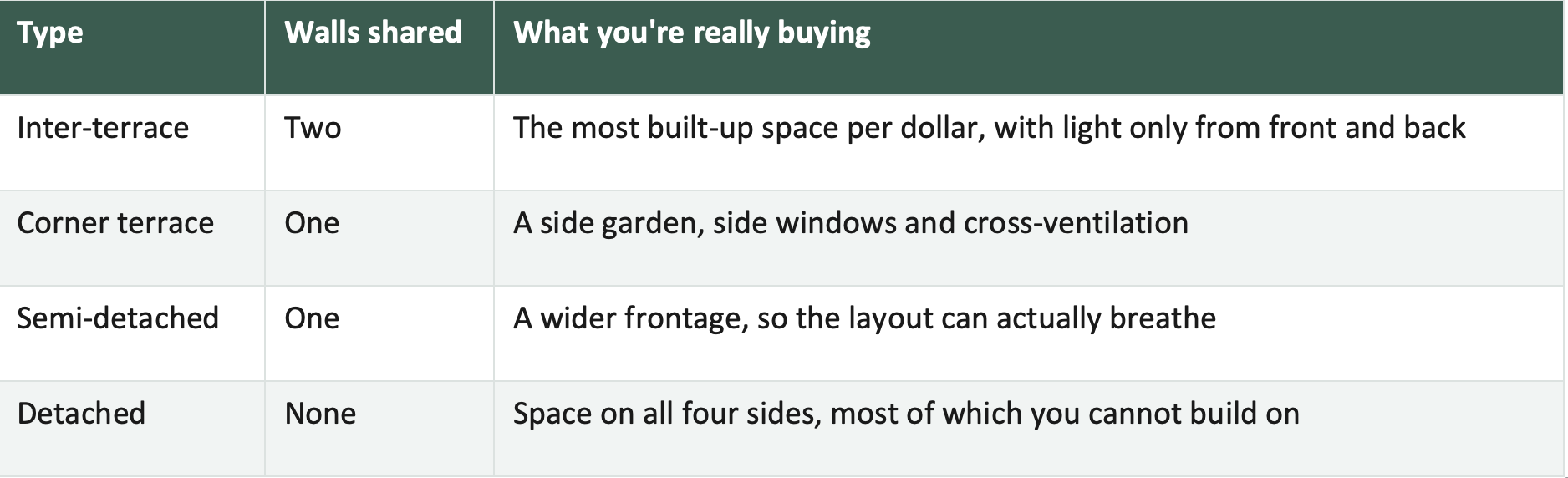
Landed Properties in Singapore at a glance
Inter-terrace: efficient, and darker than you expect
An inter-terrace sits between two neighbours. Because both side walls are party walls, you build right up to them, so you convert more of your land into floor area than any other type. That is why it is the entry point into landed living and why the price per square foot of land looks so attractive.
The constraint is light and air. Your only external faces are the front and the rear, and a typical terrace plot is deep and narrow. The middle of the house - which is usually where the staircase, the dining area and one of the bedrooms end up - has no window to the outside at all. Well-designed terraces solve this with an air well, a central courtyard or a skylight over the stair. Badly designed ones just stay dim, and you feel it every day.
The other thing to know is that a rebuild involves two neighbours. Your party walls are shared structures, and demolishing or building against them requires their cooperation and a careful structural approach. It is entirely doable. It is not something to discover after you have signed.
Corner terrace: the premium is real, but the maths surprises people
A corner terrace sits at the end of a row, so it shares one party wall and has one open side. It commands a clear premium over the inter-terrace next door, and buyers usually assume they are paying for extra land.
You are, but not in the way you think. On the open side you have to observe a side setback from your boundary - typically two metres. So the buildable footprint does not grow in proportion to the land you paid for. Some of what you bought is legally required to stay empty.
That empty strip is the actual product. A corner terrace gives you side windows, which means cross-ventilation and daylight into the middle of the house. It gives you a side garden, a second point of access, usually a better parking arrangement, and a genuine sense of separation from your neighbours. Whether that is worth the premium depends on how you live, not on the price per square foot.
Semi-detached: paying for more than just the extra square feet
A semi-detached shares one party wall with its neighbour, while a corner terrace also shares just one. So at first glance, the premium can be difficult to justify — especially when both can have similar land sizes. The difference is what sits around the house.
With a semi-D, the open side is part of the property's own configuration rather than simply being the leftover edge of a terrace row. This can give you greater separation from the neighbouring house, more freedom in how the home is positioned and designed, and often a stronger sense of having your own house on its own plot, rather than being the end unit of a row.
And this matters when you rebuild. You are designing around one party wall instead of two, with an open side that can influence the layout, windows, access and outdoor space. The premium isn't necessarily buying you dramatically more land — you're paying for the combination of land, openness and the greater freedom that comes with the property being semi-detached.
That's what makes a semi-D a different category of landed home, even when the numbers on the land title don't look dramatically different.
Detached and bungalow: paying for the space you cannot build on
A detached house shares no walls. It sets back from every boundary, which means the buildable footprint is a smaller fraction of the plot than in any other type. You are paying for land that must legally stay empty, and that is precisely the point: the emptiness is what gives you light on four sides, real privacy, garden that surrounds rather than trails behind, and the freedom to design almost anything within the envelope.
Good Class Bungalows are a subset of detached houses inside gazetted areas, with much larger minimum plot requirements and stricter controls on height and site coverage. It is a separate market with a separate buyer pool, and the rules that apply there do not carry over to ordinary detached houses.
Cluster housing: landed living, with a different form of ownership
Cluster housing can give you many of the things buyers associate with landed living — your own entrance and multiple levels. But legally, it is typically a strata-titled property within a development, rather than an individually owned plot of land.
That means there is usually a management corporation, maintenance fees and shared areas or facilities. The trade-off is fairly straightforward: you give up some control in exchange for convenience. The roof, landscaping, pool and common areas are maintained collectively, but you also cannot treat the property in quite the same way as an individually owned landed plot when it comes to alterations or rebuilding.
There is also an important distinction for PRs and foreigners. Strata landed units within an approved condominium development are generally not treated as restricted residential property under the Residential Property Act, so they can be purchased without the approval required for restricted landed property. If eligibility matters to you, establish the property's legal classification early — before getting too far into the viewing process.
What actually moves the price on the same street
Once you are comparing two houses of the same type on the same road, the differences that drive value are:
● Frontage width: A wider plot is worth more per square foot than a narrow one of the same area, because it builds better.
● Plot shape: A rectangular plot builds efficiently. An irregular or wedge-shaped plot loses usable area to awkward corners and setbacks.
● The buildable envelope: Whether the zoning allows two storeys or three, and whether an attic and a basement are feasible, changes how much house you can eventually have.
● The road: A quiet cul-de-sac against a main-road frontage is one of the largest single differences in price, and it is also the one you cannot renovate away.
● Orientation: Which way the long face points decides how hot the house is in the afternoon and how much you will spend cooling it.
● Encumbrances: A drainage reserve or a road line across the plot quietly removes buildable area. This is worth its own article, and it has one.
So which should you buy
If your priority is getting into landed at the lowest entry price and you are willing to renovate thoughtfully for light, an inter-terrace is the honest answer and there is nothing second-rate about it.
If you want the terrace price band but need cross-ventilation and a garden your children can use, the corner terrace premium is usually worth it.
If layout and the feeling of a standalone home matter most, stretch to a wide semi-detached before you stretch to a narrow detached. And if you are buying to rebuild, work out the rebuild first, because the plot decides the cost and the cost decides what the plot is worth to you.
What I would check before you view anything
For any house you are seriously considering, I put together the zoning and permitted storey height, the plot area, frontage and shape, the tenure, and what the last comparable houses on that street actually transacted for.
If there is a house you are curious about, send me the address and I will tell you what I know about it. Most of my conversations start exactly that way.